
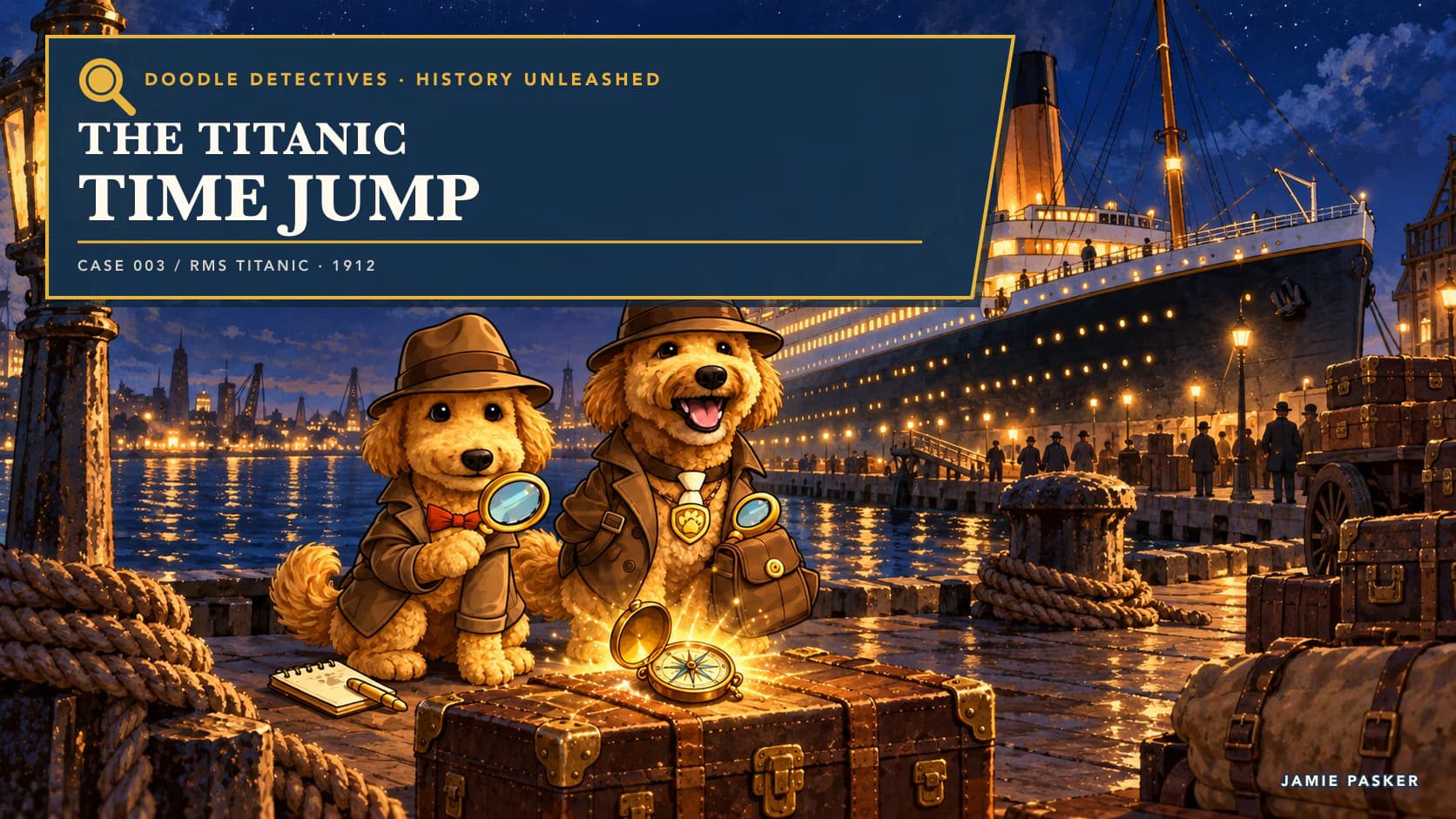
April 10, 1912. Southampton, England. The world's largest moving object prepares to set sail on its maiden voyage across the Atlantic. Crowds gather, cameras flash, and passengers wave from the decks of the RMS Titanic—a ship so magnificent, so advanced, that many believed it was unsinkable.
Four days later, it would rest at the bottom of the ocean.
The story of the Titanic is one of ambition and tragedy, engineering marvels and human error, unimaginable loss and extraordinary courage. It's a story that still echoes more than a century later—and it's one that Teddy and Copper will one day help preserve.
The Ship of Dreams ✨
When the Titanic was built, it represented the pinnacle of human achievement. At 882 feet long and weighing over 46,000 tons, it was the largest ship in the world—nearly as long as three football fields placed end to end.
But size wasn't everything. The Titanic was also a floating palace, designed to offer unparalleled luxury to its first-class passengers:
- A grand staircase made of ornate oak with wrought-iron railings
- A heated swimming pool—one of the first on any ship
- A gymnasium, squash court, and Turkish baths
- Fine dining rooms serving gourmet meals prepared by world-class chefs
- Luxurious cabins with private bathrooms, sitting areas, and even fireplaces
"She was the ship of dreams—a vessel that promised adventure, luxury, and a new beginning across the ocean."
But the Titanic wasn't just for the wealthy. It also carried hundreds of third-class passengers—immigrants seeking a better life in America, families chasing dreams, and individuals willing to risk everything for a chance at a new start.
Setting Sail 🌊
On April 10, 1912, the Titanic departed from Southampton with over 2,200 passengers and crew aboard. Its destination: New York City. The journey was expected to take about a week.
The ship made stops in Cherbourg, France, and Queenstown (now Cobh), Ireland, to pick up additional passengers. Then, on April 11, it steamed into the open Atlantic, bound for America.
For the first few days, the voyage was smooth and uneventful. Passengers marveled at the ship's grandeur, enjoyed fine meals, and relaxed in luxurious accommodations. Many believed they were part of history—sailing on the greatest ship ever built.
They had no idea how right they were.
The Fateful Night 🧊
April 14, 1912. The night was clear and calm—almost too calm. The ocean was like glass, with no wind and no waves. Under normal circumstances, this would be ideal sailing weather. But on this night, it would prove deadly.
11:40 PM: The Iceberg
Lookout Frederick Fleet spotted something ahead—a massive iceberg, directly in the ship's path. He rang the warning bell three times and called the bridge:
"Iceberg, right ahead!"
The crew reacted immediately, turning the ship hard to port (left) and reversing the engines. But the Titanic was enormous, and at nearly 22 knots (25 mph), it couldn't turn quickly enough.
The ship's starboard (right) side scraped along the iceberg for less than 10 seconds. To passengers, it felt like a minor bump—many barely noticed. But below the waterline, the iceberg had torn open the hull, flooding six watertight compartments.
The Titanic could survive flooding in four compartments. But six? It was doomed.
12:00 AM: The Realization
Captain Edward Smith and the ship's designer, Thomas Andrews, assessed the damage. Andrews' conclusion was grim: the ship would sink in less than two hours.
The "unsinkable" Titanic was going down.
Evacuation: Courage in Crisis 🛟
As the situation became clear, the crew began loading lifeboats. But there was a problem: the Titanic only had 20 lifeboats, enough for about 1,178 people. There were over 2,200 people on board.
The evacuation followed the unwritten rule of the sea: "Women and children first." Crew members helped passengers into lifeboats, many of which were launched only partially full because people didn't yet believe the ship was truly sinking.
The Band Played On 🎻
As chaos spread across the decks, the ship's eight-member band assembled and began to play. They performed upbeat ragtime tunes, waltzes, and hymns—anything to keep passengers calm.
The musicians played for over two hours, even as the ship tilted at impossible angles and water rushed across the decks. Not a single band member survived. But their courage—and their music—gave comfort to hundreds in their final moments.
Everyday Heroes
In the midst of tragedy, countless acts of bravery emerged:
- Crew members who helped passengers into lifeboats, knowing they likely wouldn't survive themselves
- Passengers who gave up their lifeboat seats so others could live
- Parents who put their children into the arms of strangers, hoping they'd reach safety
- Strangers who comforted each other in the darkness, singing hymns and holding hands
"These are the moments Teddy and Copper are sent to preserve—not the grand events, but the small acts of humanity that shine brightest in the darkest times."
2:20 AM: The Sinking 🌊
At 2:18 AM, the Titanic's lights flickered and went out. The ship broke in half between the third and fourth funnels. The stern (back) rose nearly vertical before plunging into the ocean.
At 2:20 AM—less than three hours after striking the iceberg—the RMS Titanic disappeared beneath the waves, settling 12,500 feet to the ocean floor.
More than 1,500 people lost their lives that night. The frigid North Atlantic water was only 28°F—those who ended up in the water had minutes, not hours, to survive.
The Rescue 🚢
The nearest ship, the RMS Carpathia, had received the Titanic's distress signals and steamed at full speed through iceberg-filled waters to reach the survivors. It arrived at 4:00 AM—nearly two hours after the sinking.
The Carpathia rescued 705 survivors from the lifeboats. They were cold, traumatized, and heartbroken—many had lost entire families.
Why the Titanic Still Matters 💙
The story of the Titanic is more than a maritime disaster. It's a story about human ambition, hubris, tragedy, and resilience.
Lessons Learned:
- Safety regulations changed forever. After the Titanic, new laws required ships to carry enough lifeboats for every passenger, maintain 24-hour radio watches, and conduct regular lifeboat drills.
- The International Ice Patrol was created to monitor icebergs in the North Atlantic and warn ships of danger.
- We learned humility. No ship—no matter how advanced—is truly "unsinkable."
Stories Worth Preserving:
But beyond the facts and statistics, the Titanic is filled with human stories—stories of love, sacrifice, bravery, and kindness. These are the stories that matter. These are the moments Teddy and Copper help us remember.
"Some stories are too important to forget. The Titanic reminds us that even in tragedy, humanity shines through."
One day, Teddy and Copper will travel back to that fateful night—not to change history, but to preserve the small moments of kindness that might otherwise be lost to time. 🐾
Further Reading 📚
Want to learn more about the Titanic? Here are some great resources:
- Encyclopedia Titanica — Comprehensive biographies of passengers and crew
- Titanic Museum (Belfast, Northern Ireland) — Built where the ship was constructed
- "A Night to Remember" by Walter Lord — A detailed account of the sinking
- Woods Hole Oceanographic Institution — Explore the wreck site and artifacts
History is alive in every story we tell. And every story deserves to be remembered. 🌟